


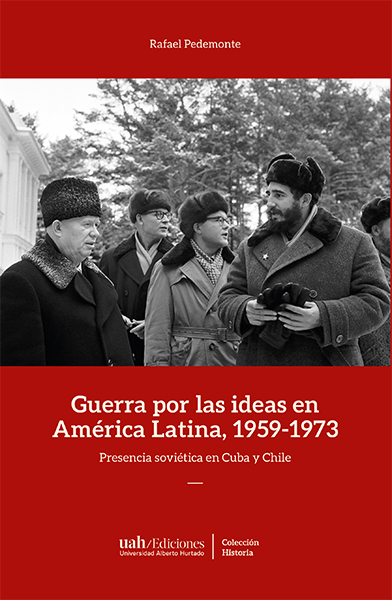
War of Ideas in Latin America (1959-1973)
Soviet presence in Cuba and Chile
$23.000
The fall of the Soviet Union (USSR) at the end of 1991 produced a break in the way of approaching the study of international relations, significantly renewing the academic perspectives dominant until then. A new crop of young researchers, less bogged down in old ideological rivalries, set out to overcome old notions and emphasize novel aspects—such as the role of culture—in order to provide a more complex vision of the priorities of conflicting states. In this way, the East-West confrontation began to be understood as a singular phenomenon; as a “battle” in which the struggle for the ideas of individuals often displaced the will for territorial superiority or military confrontation. But although studies that elevate cultural interactions as key axes of the Cold War have been fruitful in Anglo-Saxon historiography, the Soviet perspective on the matter is still in an incipient phase.
View index and first pagesBuy it in digital format on various platforms such as:


War of Ideas in Latin America (1959-1973) Soviet presence in Cuba and Chile
| Autor | Rafael Pedemonte |
|---|---|
| Portada | Ver portada |
| Year | 10-2020 |
| Nº de páginas | 446 |
| ISBN | 978-956-357-258-2 |
| ISBN digital | 978-956-357-259-9 |
Ivory paper
Rustic cover
Measures 23 x 15 cm.
Interior Between.
Rafael Pedemonte
Chile. He completed his doctoral studies under a cotutelle program between the Sorbonne University (Paris 1) and the Pontifical Catholic University of Chile. Subsequently, he completed a postdoctoral fellowship at Ghent University, Belgium. He currently works as a professor and researcher (Maître de conférences) at the University of Poitiers, France. He has written numerous articles in Spanish, French, and English on the Cold War in Latin America, particularly in Cuba and Chile, favoring a dual political-cultural perspective. His current project delves into the rootsRelated books

History
History

History


History
History

History


History
History

History

History