


Search Results for:

October
Can Christianity disappear in Latin America? Is it still possible to think of a future for Christianity? In a continent marked by religious pluralization, the loss of institutional relevance, and the church's crisis of credibility, the notion of exculturation, coined by Danièle Hervieu-Léger for the French context, suggests that Christianity would no longer be capable of providing horizons of collective meaning, beyond exclusively individual constructions.
Is this notion relevant to our continent? If it is not yet today, could it become so in the future? Given the profound transformations in Latin American societies and the place of the religious within them, it is urgent to return to the spiritual sources that have given life to the history of our continent. Only through the rearticulation of Christianity, theology, and spirituality will it be possible to give birth to a new Christian style, capable of living in contexts of a diaspora Church.

October
Wednesday, October 08 → 5 PM → Roberto Bellarmino Hall. Central House → Av. Bernardo O’Higgins 1825. Los Héroes Metro Station. Downtown Santiago. «The Force of Law. Mariana Valverde. Translation by Javiera Araya-Moreno» This fascinating book, in which author Mariana Valverde, travels through different countries and realities, seeks situations that illustrate the concepts...

October
14th Primavera del Libro 2025 → From October 3 to 5 → 11 AM to 9 PM → Estadio Nacional Park → Estadio Nacional Metro Station, Line 6 – Ñuñoa. → Booth 75. A new edition of the 14th Primavera del Libro, organized by Editoriales de Chile, begins this Friday, October 3. This event brings together…
September
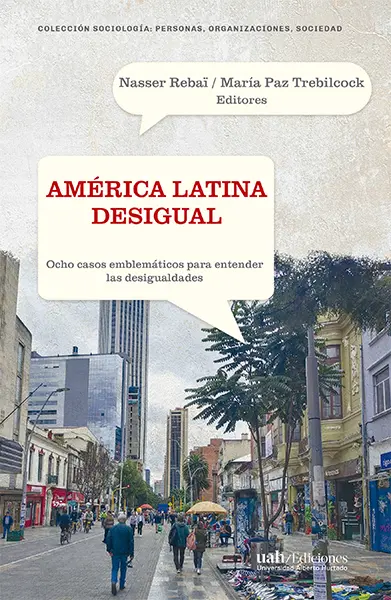
In recent decades, continuing historical struggles dating back to the colonial era, Latin America has reaffirmed itself as a land of “resistance” through significant protests and uprisings in favor of greater social and spatial justice. Protests advocating for more equity have not lost intensity in Latin America, and they help keep the question of the state's role at the center of political debate, thereby reminding us that inequalities must be addressed as an “object of public action.” This presents a major challenge in a region where citizenship increasingly views the functioning of institutions with mistrust and becomes aware of the limits of economic growth as a means to achieve well-being. This book aims to contribute along these lines by identifying the historical elements underlying the construction of these inequalities, the mechanisms of their reproduction, and some exemplary forms and cases that have managed to overcome them.


September
What is law and why is it so important? Is the rule of law identified with any particular form of government? Should citizens discuss specific laws, determining whether or not they are good for society? Do the specific laws in force in a country constitute “law”? These and many other questions are discussed in this fascinating book, in which the author travels through different countries and realities, seeking situations that illustrate the philosophical concepts of law in contemporary societies.

September
Wednesday, September 10th → 6 PM → Roberto Bellarmino Hall. Central House → Av. Bernardo O'Higgins 1825. Los Héroes Metro. Downtown Santiago. «The Fabric of Criticism. An Anthology of Readings. Javier Edwards.» The presentation of this book will be led by two writers with extensive careers in Chilean literature. The book...